联系我们
Contact
The lab continuously recruits postdoctoral researchers, PhD and master's students, and welcomes undergraduates for research training.
Contact details
- taoyaoyutyy@pku.edu.cn
- Phone
- +86-13095698730
- Address
- Micro-Nano Electronics Building, Room 323
Peking University, 5 Yiheyuan Road, Haidian District, Beijing - Second office
- Ziyuan West Building 2208B (Institute for Artificial Intelligence)
- Postcode
- 100871
- Lab website
- leap-pku.com
Host institutions
School of Integrated Circuits, Peking University
ic.pku.edu.cn
Institute for Artificial Intelligence, Peking University
ai.pku.edu.cn
Please state your purpose in the subject line (for example "PhD application", "Collaboration enquiry" or "Course question") so that we can reply promptly. Because of the volume of email, replies usually take up to three working days; a follow-up message is welcome if you have not heard back.
Finding us
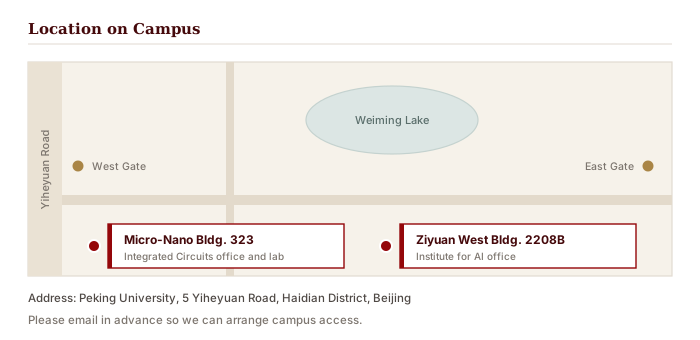
Both offices are on the Peking University campus, about fifteen minutes apart on foot. Any of the map services below will take you to the right building.
Micro-Nano Electronics Building 323
School of Integrated Circuits office and lab
Peking University, 5 Yiheyuan Road, Haidian District, Beijing
Ziyuan West Building 2208B
Institute for Artificial Intelligence office
Peking University, 5 Yiheyuan Road, Haidian District, Beijing
Openings
Most projects here span two or three layers, so we care more about willingness to learn a new layer than about an exact match of background on arrival.
Postdoctoral researchers
Positions are open year-round. The role suits applicants with a background in integrated circuit design, computer architecture, device physics or machine learning systems who want a complete research experience at the tape-out level. The lab provides process platforms, tape-out resources and industrial application settings, and postdocs can lead a full project.
Materials: academic and professional background, two representative papers, and a one-page research plan explaining what you would like to do here and why it needs to be done here.
PhD students
Admission is through the normal channels of the School of Integrated Circuits or the Institute for Artificial Intelligence, including recommendation, application-assessment and direct-entry routes. Getting in touch a year ahead makes it easier to arrange preliminary research or an internship.
Materials: academic and research background, transcript, and a short statement of research interests. Course projects, open-source code or competition work are all welcome.
Master's students
Both academic and professional master's students are admitted. Master's projects usually focus on one concrete module — peripheral circuit design, operator mapping, simulator development or prototype validation — and are carried out in a small group with PhD students.
Undergraduate research
Peking University undergraduates are welcome to join through the undergraduate research training programme, final-year projects or summer research. Students who have taken our courses can continue their course project directly. Undergraduates from other universities interested in summer research should get in touch before March each year.
Frequently asked questions
- Can I apply without a chip design background? Yes. Current members come from integrated circuits, computer science, physics and automation. A foundation in architecture, compilers, algorithms or device physics all provides a way in, and the rest can be filled after joining.
- Is the work all simulation? No. Most projects go through to tape-out and measurement, and members take part in the whole process from design through fabrication to test board bring-up. That is also why we share process platforms with partners.
- Can I take part remotely? Short-term algorithm or simulation work can be done remotely, but circuit design and measurement need to happen on campus.
- How far can undergraduates go? Undergraduates have been co-inventors on patent applications, and some of their work has gone into published papers. It depends on the time invested and the state of the project.
- How can companies collaborate? See the forms listed on the Collaboration page; email is the way to start.